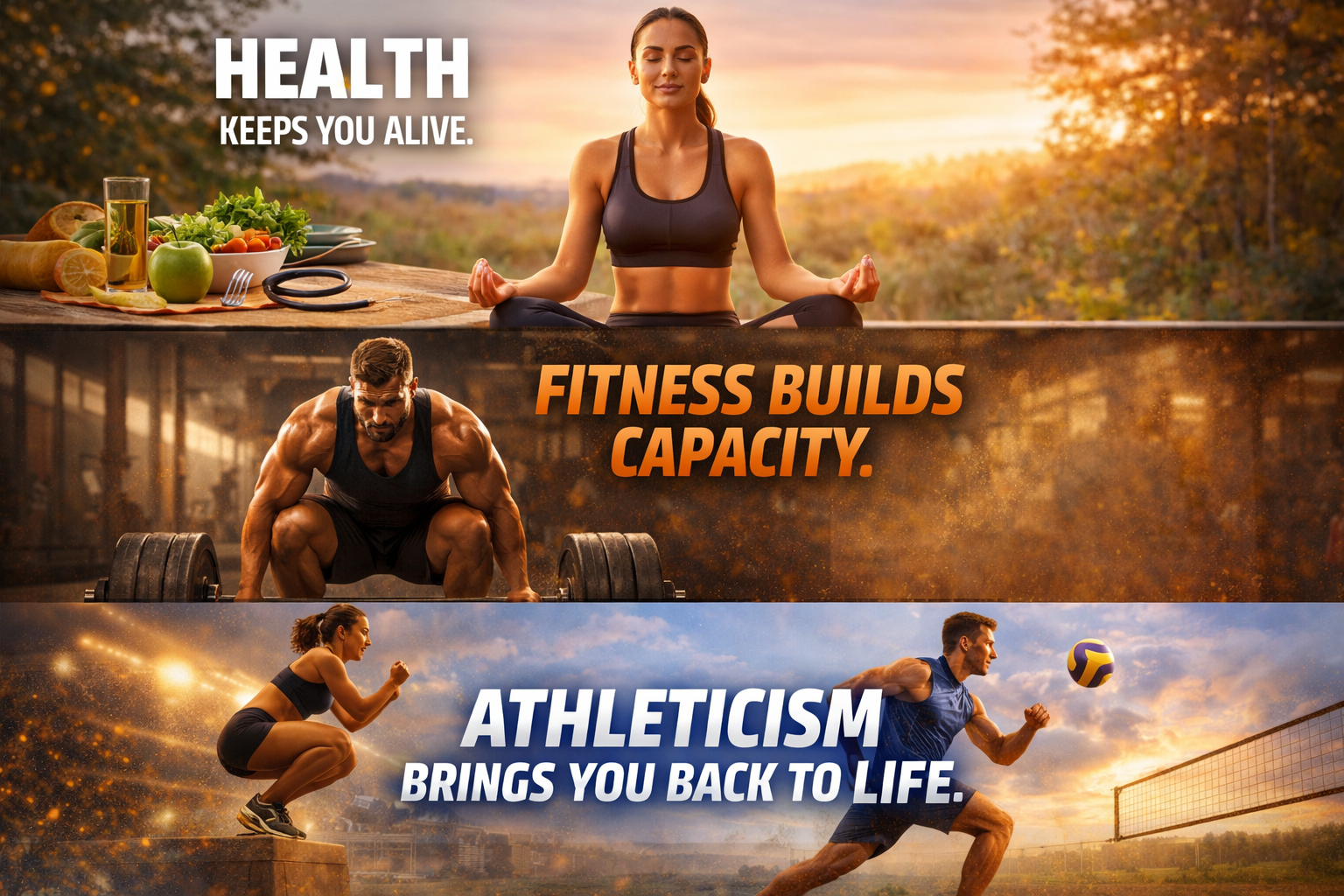
Most adults chase health. Some chase fitness. Almost nobody trains for athleticism.
And that’s exactly why they never look, move, or feel like they used to.
The Problem
We’ve collapsed three completely different ideas into one messy goal.
Health.
Fitness.
Athleticism.
People treat them like they’re interchangeable.
They’re not.
So what happens?
You get someone who eats clean, walks daily, sleeps 7 hours…
And still moves like their body is stiff, slow, and fragile.
Or someone who lifts weights and does cardio…
But pulls a hamstring sprinting, can’t change direction, and avoids anything “explosive.”
That’s because most people are training for maintenance, not performance.
They’re checking boxes:
“I worked out”
“I hit my steps”
“I’m staying healthy”
But they’ve lost the one thing that actually makes the human body resilient and capable:
Athletic ability.
The Truth
Health, fitness, and athleticism are not the same game.
They’re stacked.
And if you don’t understand the order—you'll train the wrong way forever.
Here’s the reality:
- Health = your baseline survival system
- Fitness = your engine capacity
- Athleticism = how well you can actually use that engine in real time
Research is painfully clear on this:
You can be healthy without being fit.
You can be fit without being athletic.
And you can be athletic… while slowly breaking your body.
But here’s the hierarchy most people miss:
Athleticism sits at the top.
And it demands the other two.
You don’t accidentally become athletic.
Athleticism is earned.
Built on health.
Layered with fitness.
Expressed through performance.
That's why the highest performers don't just exercise.
They train to perform but stacking their progress.
How the Stack Actually Works
Let’s break this down simply.
1. Health = System Stability
This is your foundation.
It’s driven by:
- Sleep quality
- Nutrition
- Stress regulation
- Hormonal balance
When these are off, everything downstream suffers.
No recovery.
No adaptation.
No performance.
This is why inactivity is directly linked to chronic disease.
Your body isn’t designed to sit still—it’s designed to adapt.
2. Fitness = Engine Capacity
Now we layer in output.
Fitness is your ability to:
- Produce energy (cardio)
- Produce force (strength)
- Sustain effort (endurance)
This is where VO₂ max, strength progression, and conditioning live.
It’s measurable.
Trainable.
Predictable.
And yes—higher fitness levels are strongly tied to lower mortality risk.
But here’s the catch:
Fitness doesn’t guarantee usable performance.
You can squat heavy…
And still tear something when you try to move fast.
3. Athleticism = System Integration
This is where everything changes.
Athleticism is about how fast and efficiently your brain and body work together.
It’s driven by:
- How quickly you produce force
- Movement coordination and efficiency
- Dynamic stability and resistance to injury
- Ability to acquire a new movement skill
Athleticism is what happens when strength meets functional coordination and speed.
It’s the difference between:
Lifting weights
vs
Moving like you own your body
Strong ≠ athletic
Fit ≠ athletic
Healthy ≠ athletic
But:
Athletic = healthier, stronger and more fit than the rest.
Build the Stack: Train Like an Athlete
If you want to move, feel, and perform like an athlete again…
You don’t start at the top.
You build the stack.
Step 1: Lock in Health (Non-Negotiables)
Before anything else:
- Sleep 7–8 hours
- Eat like an athlete (real protein sources, plenty of vegetables, consistency)
- Manage stress
- Move daily
This is your recovery system.
Without it, nothing sticks.
Step 2: Build Fitness (Capacity)
Now earn your engine.
Train:
- Strength (progressive overload)
- Cardio (preferably via strength training and non-machine based conditioning)
- Mobility (active, not passive)
This is where most people stop.
And it’s why they plateau.
Because capacity without application is wasted.
Step 3: Train Athleticism (Expression)
This is the missing layer.
This is where you:
- Sprint
- Jump
- Change direction
- React
- Decelerate
- Coordinate complex movement
This is where you train:
Power. Not just strength.
Dynamic control. Not just stationary exercises.
You’re teaching your body to:
- Coordinate high performance movement with power and safely
- Stabilize under dynamic and unpredictable conditions
- Adapt to the all situations life throws at you
That's what makes your body resilient and injury-resistant.
That’s what brings your body back to life.
That's what allows you to be a high performing athlete for life.
The Shift Most Adults Need
Right now, most people are stuck here:
“I just want to be healthy.”
Cool.
But that mindset leads to:
- Low intensity
- Safe, repetitive movement
- Minimal progression
And eventually:
Decline.
Because the body adapts to demand.
And if the demand is low…
So is your capacity.
Our Athlete For Life Standard
Health isn't the goal. It's the baseline.
We train for athleticism.
Because to sustain athleticism, you are forced to:
- Maintain fitness
- Respect recovery
- Take care of your body
It pulls everything up with it.
Instead of asking:
“Did I work out?”
You ask:
“Can I move better, faster, and stronger than last month?”
That's a higher level game.
The Bottom Line
Health keeps you alive.
Fitness builds your engine.
Athleticism teaches you how to use it.
If you stop at health—you maintain.
If you stop at fitness—you plateau.
But if you train for athleticism—
You rebuild the body you thought you lost.
Train like an athlete.
Because performance is the only look that lasts.


